

On July 23, 2025, the International Court of Justice (ICJ), the principal judicial organ of the United Nations, issued a historic, unanimous advisory opinion that transformed long-evolving principles of environmental law into clear and explicit legal obligations.
Before the Court were two fundamental questions: What obligations do states have under international law to address climate change for present and future generations? And what legal consequences arise when states fail to fulfil those obligations?
In its assessment, the Court affirmed that states are under binding duties to protect the climate system and prevent foreseeable environmental harm. Crucially, it ruled that failure to meet these obligations constitutes an internationally wrongful act, engaging full State responsibility under international law. By clarifying exactly what states are legally required to do, and who bears the primary responsibility when those obligations are breached, the ruling fundamentally shifts the landscape of global environmental accountability.
Delivering the opinion at the Peace Palace in The Hague, Yūji Iwasawa, President of the ICJ, emphasized the gravity of the issue, describing climate change as “more than a legal problem; it is an existential crisis of planetary proportions that imperils all forms of life and the very health of our planet.”
The Origin Story
The significance of the Court’s ruling extends beyond the legal principles it articulated. It represents the culmination of years of advocacy led by environmental leaders and by some of the communities most vulnerable to climate change, whose efforts sought to transform the lived realities of climate impacts into questions of international legal responsibility.
Back in 2015, a group of friends led by visionary attorney Tony Oposa Jr, including some of the funders of the Consortium for Ecological Law, gathered for a week-long “playshop” on the North Shore of Hawaii to “dream” the advisory opinion on the climate crisis, including how to formulate the questions and how to engage with UN missions and advocates to make the dream come true.
This process began to take shape at the 2016 IUCN World Conservation Congress in Honolulu, Hawaii, which drew over 10,000 delegates from 192 countries. It was during this congress that Consortium for Ecological Law Board Members, including Nicholas Robinson, Tony Oposa, and Victor Tafur, collaborated with international diplomats, students, and activists to demonstrate that seeking an ICJ advisory opinion on climate change was a viable legal strategy. Through collaborative “play-shop” sessions, this working group brainstormed initial ideas, tested legal arguments, and began drafting the foundational questions that would eventually form the basis of the submission to the Court.
By 2019, this legal groundwork intersected with grassroots momentum. Among the most influential voices were young people from the Pacific Islands, whose campaign helped bring the issue before the world’s highest court. Twenty-seven students from the University of the South Pacific in Fiji founded the Pacific Island Students Fighting Climate Change (PISFCC). They were from communities where sea level rise, intensifying cyclones, and coral bleaching were not abstract policy debates but daily existential realities. The Pacific Islands contribute less than one percent of global greenhouse gas emissions, yet face some of the most severe and immediate consequences of climate change.
Achieving this goal required more than grassroots activism; it demanded the support of a sovereign state capable of advancing the proposal through international institutions. That champion emerged in Vanuatu, a Pacific island nation acutely vulnerable to rising sea levels and other climate-related threats. Recognizing both the urgency of the crisis and the potential of the students’ vision, Vanuatu spearheaded the diplomatic coalition that ultimately secured the UN General Assembly request.
Six years after those twenty-seven students began their campaign, the ICJ delivered its opinion. The verdict was unambiguous: all states have a legal obligation to protect the climate system from greenhouse gas emissions, regardless of their size, wealth, or emissions level.
Several aspects of the opinion proved particularly significant.
First, the opinion established that climate obligations extend far beyond climate treaties. The Court held that states’ duties arise not only from the UNFCCC, Kyoto Protocol, and Paris Agreement, but also from customary international law, international human rights law, the law of the sea, biodiversity agreements, and other sources of international law. Climate protection is therefore not confined to a single treaty regime.
Second, rejecting arguments that 1.5°C was merely aspirational, the Court affirmed it as the Agreement’s primary temperature objective. States must exercise due diligence when preparing and implementing their climate commitments, ensuring that national action is genuinely directed toward achieving that goal.
Third, the Court found that failures to take appropriate climate action, including continued fossil fuel expansion, subsidies, or inadequate regulation, may constitute internationally wrongful conduct attributable to a state.
Fourth, the Court confirmed that international cooperation forms part of states’ legal responsibilities. Financial assistance, technology transfer, and capacity-building for vulnerable states are not simply matters of political goodwill.
Fifth, the Court reiterated that a healthy environment is integral to human rights. Environmental degradation and climate change, the Court held, directly impair the enjoyment of internationally protected human rights, reinforcing the growing recognition of a right to a clean, healthy, and sustainable environment.
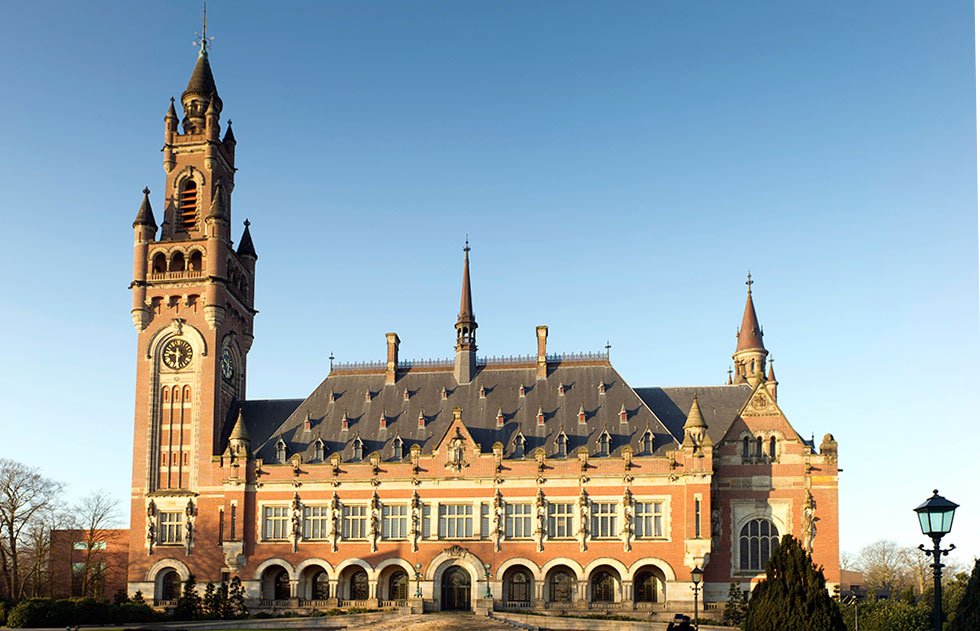
Image Source: International Court of Justice
Overcoming the Deficit of Time
While the ICJ’s advisory opinion marks a groundbreaking milestone, the true test lies in implementation. In his analysis of global environmental governance, Professor Nicholas A. Robinson, President and Chairman of the Consortium for Ecological Law, notes that for five decades since the 1972 Stockholm Conference, humanity has continuously constructed frameworks, yet has repeatedly allowed “business as usual” to delay drastic action.
The core challenge facing this new legal era is no longer just a lack of rules, but a severe shortage of time. As Robinson powerfully observes:
“Beyond depleting the resources of Earth’s natural and physical environment, humanity has also depleted time itself. There is not enough time left to permit the pace of environmental law-making to lead to success. Political will has eroded too, leaving ‘business as usual’ to continue to harm the environment.”
Historically, international policy agreements have unraveled when forced to compete with domestic budgets, political intertia, and state sovereignty. In their article, “State Responsibility for Disrupting Earth’s Climate System: Anticipating the ICJ Advisory Opinion,” Robinson and a cohort of young legal scholars examined the profound implications of the International Court of Justice’s ruling. They argued that the stagnation of global climate governance is entirely a crisis of political inertia. They stated that “[t]he policies and technologies exist to cope with climate change… Similarly, the means to implement the SDGs are available,” yet “States are not committing sufficient resources or actions proportionate to their duties to protect the climate system.”
The ICJ’s ruling provides a powerful mechanism to combat this stagnation. By formalizing state obligations, the international community opens a pathway for domestic courts around the world to hold their respective governments accountable. If local judiciaries can aggressively apply these newly clarified international obligations to safeguard the fundamental right to a healthy environment, we can finally bypass deadlocked global politics. As Robinson concludes, we no longer have another 50 years to wait. The ICJ has given the world the legal backing it needs; now, the public and local courts must use it to force an end to “business as usual” before our collective time completely runs out.
The Paradigm Shift to Ecological Law
This ICJ opinion moves international law in exactly that direction, declaring that the environment is “the foundation for human life” and that protection of the climate system is a legal obligation that cannot be subordinated to economic interests.
The opinion’s recognition of the human right to a clean, healthy, and sustainable environment directly aligns with the principles embedded in rights of nature law, which recognizes ecosystems as legal subjects with their own claims. The finding that COP decisions can carry legal weight reinforces the legal architecture within which ecocide law arguments are increasingly being made. Furthermore, it builds on the foundational body of environmental law that has been developing since the 1970s, interpreting that body of law at its most authoritative level and clarifying that it creates real, enforceable obligations, not merely aspirational frameworks.
The difference between environmental law and ecological law has never been more relevant than in the context of this opinion. Traditional environmental law regulates harm to nature in service of human interests. The ICJ opinion begins to establish that the climate system itself has a claim on legal protection, and that states are accountable not just to each other but to present and future generations and to the integrity of the Earth’s natural systems.
What Comes Next: The Consortium’s Strategic Focus
The true value of the ICJ’s opinion does not lie in the text itself, but in how it is operationalized. Organizations like the Consortium for Ecological Law are working to translate the opinion’s principles into practical governance and accountability mechanisms. Rather than treating Earth-centered law as a distant philosophy, the Consortium acts as a strategic bridge, taking the high-level principles affirmed by the ICJ and embedding them directly into global policy mechanisms.
The ICJ opinion has successfully set the international legal compass, but the defining question of the next decade of climate action rests entirely on how the international community implements it. To ensure this momentum is not lost, the Consortium for Ecological Law is actively giving close attention to several fast-moving, recent developments
1. The UNGA Endorsement Resolution: Following months of intensive negotiations, the UN General Assembly adopted Resolution 80/263 on May 20, 2026. Tabled by Vanuatu and a cross-regional core group, the resolution passed with a supermajority of 141 votes in favor, formally endorsing the ICJ opinion. The Consortium is now closely monitoring how this newly established multilateral framework will be used to translate the Court’s legal findings into actionable compliance and accountability metrics across the UN system.
This formal adoption exposed deep geopolitical fault lines regarding how much authority the international community should have over domestic energy grids. Leading the opposition, the United States firmly rejected giving any operational weight to the ICJ’s findings, arguing that the resolution improperly treats a non-binding advisory opinion as an irrefutably authoritative mandate. This pushback was framed fundamentally as an issue of national sovereignty; opponents cautioned that allowing an international judicial body to dictate “due diligence” environmental standards would create an expansive legal rule that impermissibly interferes with a state’s sovereign right to independently regulate, manage, and transition its own domestic energy policy.
Beyond sovereignty, the central point of contention during the General Assembly debate was whether climate accountability belongs exclusively within voluntary political agreements or if it can be governed by broader international law. Powerful fossil-fuel-producing states, notably led by Saudi Arabia, aggressively pushed to keep all climate obligations strictly confined to the existing UN Framework Convention on Climate Change (UNFCCC) and the Paris Agreement. They warned that using a General Assembly resolution to operationalize the ICJ’s opinion creates a dangerous precedent, giving the false impression of “extended obligations” that go far beyond what states originally and collectively negotiated. By passing the resolution despite these objections, the Assembly signaled that the Paris Agreement is no longer a shield against broader legal accountability under international environmental and human rights treaties.
2. New Climate Litigation: The Consortium is focusing on how legal teams in multiple jurisdictions are already weaponizing the opinion’s findings in ongoing and new climate cases. They are monitoring domestic courts in Europe, Latin America, Asia, and the Pacific, which are expected to see a wave of cases citing the ICJ’s interpretation over the next two to three years.
3. The Post-COP30 Implementation Benchmark: Following the submission deadline for updated NDCs at the end of the COP30 cycle, the Consortium is shifting its focus toward the upcoming COP31 summit. This next phase serves as a critical testing ground to measure whether states are translating their newly updated national targets into domestic policies that actually comply with the ICJ’s due diligence standards.
For decades, climate governance has been defined by political commitments that often proved difficult to enforce. The ICJ’s advisory opinion does not solve the climate crisis, but it fundamentally changes the legal landscape in which it unfolds. By clarifying that climate protection is a matter of legal obligation rather than political discretion, the Court has provided governments, communities, advocates, and judges with a powerful new framework for accountability. The challenge now is not determining what the law requires. The challenge is ensuring that those requirements are implemented before time runs out.